
EU27 chemical export value falls 42% YoY in Jan-Feb 2026, distorted by anomalous 2025 base.
Key takeaway
The EU27 chemical industry experienced a sharp contraction in the first two months of 2026, with exports falling 42% in value to 34.4 bn€, down 25.1 bn€ from 2025, though this figure reflects an anomalous February 2025 base that reached 4.8 standard deviations above normal levels. Chemical output declined 3.9% year-on-year to an index of 79.3, remaining 18% below pre-crisis levels (2014–2019 average), while producer prices fell 2.8% to 117.2. The trade balance collapsed to just 0.21 bn€, down 12.2 bn€ from 2025, as import resilience from China (4.8% growth) and the United States (4.7% growth) contrasted with export weakness concentrated in US flows, which plummeted 72.5%. With the top-5 export partners accounting for 50% of value, the decline reflects concentrated bilateral disruptions rather than broad-based weakness across all markets.
EU27 chemical output falls 3.9% YoY in February 2026, remaining 18% below pre-crisis levels
Sector context
EU27 chemical production declined by 3.9% in February 2026 compared to February 2025, reaching an index level of 79.3. The sector remains 18% below pre-crisis levels (2014–2019 average). Chemical output underperformed total manufacturing, which declined by just 0.4% over the same period.
EU27 chemical producer prices stood at 117.2 in February 2026, down 2.8% compared to February 2025. Year-to-date, chemical prices averaged 118.0, unchanged from the first two months of 2025.
EU27 chemical sales declined by 5.6% in February 2026 compared to February 2025, with the index reaching 92.1 (2021=100, seasonally adjusted). In the first two months of 2026, chemical sales averaged 91.3, down 3.1% compared to the same period in 2025.
Country output, YoY
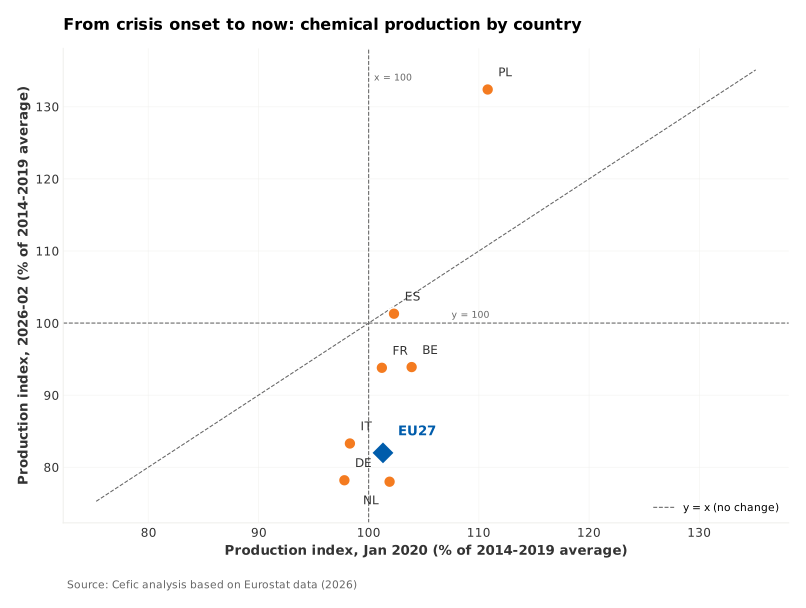
EU27 chemical production six years on: Poland alone has gained ground, the Netherlands and Germany have lost the most
Six years after the start of the COVID disruption, chemical production in most EU27 majors sits visibly below the 2014-2019 baseline. Indexed to that pre-crisis average, the Netherlands stands at 78.0 in February 2026 against 101.9 in January 2020, a 23.9 percentage-point drop relative to the no-change diagonal. Germany has lost 19.5 points (97.8 → 78.2) and Italy 14.9 (98.3 → 83.3). Belgium (-10.1 pp) and France (-7.3 pp) sit closer to the diagonal but still below it.
Poland is the only top-7 country trading above the diagonal: production stands at 132.4 versus a Jan 2020 reading of 110.8, a +21.7 percentage-point structural gain over six years. Spain has held its position almost exactly (101.3 vs 102.3, -1.0 pp), making it the only major outside Poland to have not lost ground.
The dispersion across the seven countries is wide: the gap between Poland (+21.7 pp) and the Netherlands (-23.9 pp) spans 45 percentage points of cumulative drift. Read against the 2014-2019 baseline rather than against the previous year, EU27 chemical output has not recovered for most majors, and the recovery story is concentrated on a single country.
Source: Cefic analysis based on Eurostat sts_inpr_m (I21, SCA), 2014-2019 baseline converted via I15 overlap (2026)
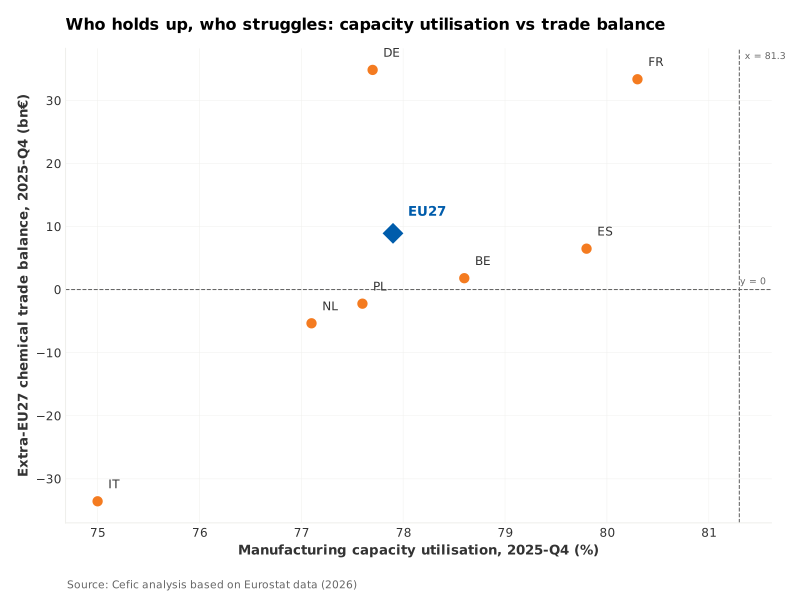
Capacity utilisation versus trade balance: who holds up, who struggles in 2025-Q4
In the fourth quarter of 2025, manufacturing capacity utilisation across the EU27 majors clustered tightly between 75% and 80%, all below the 81.3% EU average. Trade balances tell a much wider story: Germany (+34.8 bn€) and France (+33.3 bn€) carry the bloc's chemical surplus despite running at 77.7% and 80.3% CU respectively. Spain sits comfortably above zero (+6.5 bn€ at 79.8% CU), and Belgium hovers around balance (+1.8 bn€ at 78.6% CU).
Italy is the clearest struggle case: the lowest capacity utilisation in the panel at 75.0% combined with a -33.6 bn€ deficit, the most negative reading. The Netherlands and Poland sit between them, with small deficits (-5.4 bn€ and -2.2 bn€) and below-average CU (77.1% and 77.6%).
The dispersion across countries is asymmetric: capacity utilisation spans only 5.3 percentage points (75.0 to 80.3), while trade balances span 68 €bn from Italy to Germany. Demand-side conditions, not production capacity, are what currently separate winners from losers in the EU27 chemicals trade.
Source: Cefic analysis based on Eurostat BCS ei_bsin_q_r2 (BS-ICU-PC, SA) and Comext extra-EU27 trade flows, 2025-Q4 (2026)
Demand issue or price issue: where each EU27 chemical major sits in February 2026
The four-quadrant view pairs the year-on-year producer price change (horizontal) with the year-on-year production volume change (vertical) for the seven top EU27 chemical producers. Countries in the upper-right quadrant combine rising prices with rising volumes, a synchronised expansion. Lower-left points combine falling prices and falling volumes, a synchronised contraction. The off-diagonal quadrants distinguish demand-side from supply-side stress.
Most EU27 majors cluster in the lower-left in February 2026, with both prices and volumes declining. The exception is France, the only country pairing a modest volume gain with a small price decline. The dispersion on the price axis is wider than on the volume axis, indicating that price softness is broader than the volume retreat across the panel.
Source: Cefic analysis based on Eurostat sts_inppd_m (I21, NSA) and sts_inpr_m (I21, SCA), February 2026 vs February 2025 (2026)
EU27 chemical import value falls 12% YoY in Jan-Feb 2026, driven by volume decline
- Other organic basic chemicals 1.06 bn€
- Other inorganic basic chemicals 0.54 bn€
- Basic pharmaceutical products 0.49 bn€
- Other chemical products 0.32 bn€
- Plastics in primary forms 0.25 bn€
- Perfumes and toilet preparations 0.24 bn€
- Other inorganic basic chemicals 0.36 bn€
- Other chemical products 0.34 bn€
- Perfumes and toilet preparations 0.31 bn€
Trade context
From January to February 2026, EU27 chemical imports decreased by 12.0% in value in comparison to the same period in 2025. EU27 chemical imports amounted to 33.5 bn€ in the first two months of 2026, down by 4.55 bn€ compared to 2025.
EU27 chemical imports fell by 18.5% in volume and 12.0% in value between January and February 2026, reflecting lower average unit prices alongside reduced quantities.
With 4.37 bn€, China is the primary source of imports of the EU27 area for chemicals, followed by the United States (3.67 bn€) and Switzerland (1.9 bn€). Imports from China increased by 4.8%, while imports from the United States rose by 4.7%. By contrast, imports from Switzerland declined by 19.9% and imports from the United Kingdom fell by 13.3%.
Organic chemicals remained the largest import category at 9.2 bn€, down marginally by 0.3%. Miscellaneous chemical products declined by 9.1% to 1.79 bn€, while plastics and articles thereof fell by 18.4% to 1.55 bn€. Fertilisers posted the steepest decline at 47.2%, dropping to 0.36 bn€.
Imports from China increased by 0.2 bn€ (4.8%), driven by basic pharmaceutical products (1.8 bn€) and other organic basic chemicals (1.51 bn€). 5 CN 8-digit products explain 64% of the net variation over five years: 29371900 (polypeptide hormones), +0.876 bn€; 29339980 (heterocyclic compounds with nitrogen), +0.612 bn€; 29335995 (heterocyclic compounds with nitrogen), +0.529 bn€; 29349990 (nucleic acids and their salts), +0.108 bn€; 24041200 (products containing nicotine), +0.085 bn€. The largest current flow remains basic pharmaceutical products (1.8 bn€, 41% of the total).
Imports from the United States increased by 0.16 bn€ (4.7%), led by basic pharmaceutical products (1.7 bn€, 46% of the total). 5 CN 8-digit products explain 58% of the net variation over five years: 29371900 (polypeptide hormones), +1.407 bn€; 38221900 (diagnostic or laboratory reagents), +0.255 bn€; 30025100 (cell therapy products), +0.063 bn€; 28442035 (uranium enriched in U 235), -0.054 bn€; 29333999 (heterocyclic compounds with nitrogen), -0.053 bn€.
Imports from the United Kingdom decreased by 0.23 bn€ (13.3%), with other organic basic chemicals (0.24 bn€), other chemical products (0.24 bn€) and other inorganic basic chemicals (0.24 bn€) representing the largest categories at 16% each of the UK total.
Six years after the start of the COVID disruption, chemical production in most EU27 majors sits visibly below the 2014-2019 baseline. Indexed to that pre-crisis average, the Netherlands stands at 78.0 in February 2026 against 101.9 in January 2020, a 23.9 percentage-point drop relative to the no-change diagonal. Germany has lost 19.5 points (97.8 → 78.2) and Italy 14.9 (98.3 → 83.3). Belgium (-10.1 pp) and France (-7.3 pp) sit closer to the diagonal but still below it.
Poland is the only top-7 country trading above the diagonal: production stands at 132.4 versus a Jan 2020 reading of 110.8, a +21.7 percentage-point structural gain over six years. Spain has held its position almost exactly (101.3 vs 102.3, -1.0 pp), making it the only major outside Poland to have not lost ground.
The dispersion across the seven countries is wide: the gap between Poland (+21.7 pp) and the Netherlands (-23.9 pp) spans 45 percentage points of cumulative drift. Read against the 2014-2019 baseline rather than against the previous year, EU27 chemical output has not recovered for most majors, and the recovery story is concentrated on a single country.